Table of Contents
Toggle👔 Top 50 Most Powerful CEOs in the World 2026 👔
The Ultimate Rankings of Global Business Leaders
In 2025, the world's most powerful CEOs are navigating unprecedented technological transformation, economic uncertainty, and global competition. From AI pioneers revolutionizing computing to banking titans managing trillions in assets, these visionary leaders are shaping industries, driving innovation, and creating extraordinary shareholder value. Their strategic decisions impact billions of lives worldwide, making them the most influential business executives on the planet.
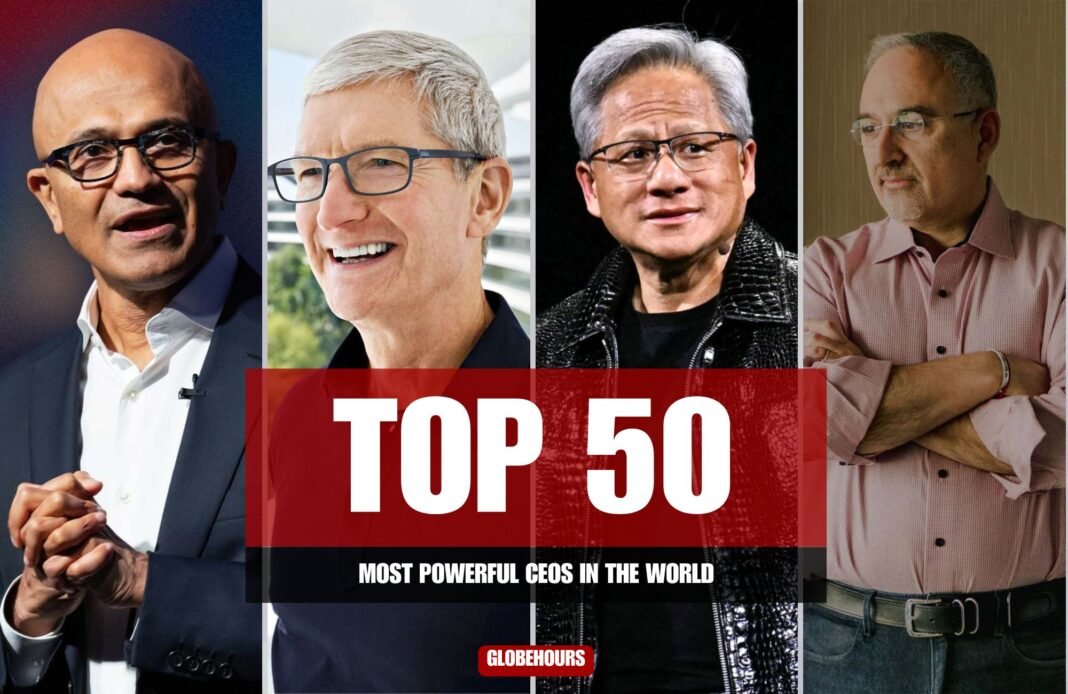
Satya Nadella
Microsoft's CEO tops the 2025 rankings with an exceptional 95.6 brand strength score. Since taking the helm in 2014, Nadella has transformed Microsoft into a $3+ trillion company through cloud computing dominance with Azure and strategic AI partnerships with OpenAI. His leadership delivers 26% annual brand value growth while navigating complex relationships and massive infrastructure investments in the AI era.
Tim Cook
Apple's CEO maintains the company's position as the world's most valuable brand with a 93.2 brand strength score. Cook has expertly managed the iPhone ecosystem while expanding into services, wearables, and the Vision Pro spatial computing platform. His supply chain mastery and commitment to sustainability have made Apple a $3 trillion+ company under his stewardship.
Jensen Huang
NVIDIA's founder has led the AI computing revolution, propelling the company to a 98% brand value surge to $87.9 billion. Huang's vision for GPU-powered AI infrastructure has made NVIDIA indispensable for training large language models. His continuous innovation in reasoning models, agentic AI, and robotics keeps NVIDIA ahead of competitors while creating new partner opportunities.
Antonio Neri
HPE's CEO earned the #1 spot as Most Influential Executive of 2025 after completing the historic $13.4 billion Juniper Networks acquisition. Neri's conviction and strategic vision in battling regulatory challenges for two years demonstrated exceptional leadership. The deal positions HPE as a comprehensive networking and computing powerhouse for the hybrid cloud era.
Sundar Pichai
Alphabet's CEO leads with an 89.3 brand strength score while navigating antitrust challenges and AI competition. Pichai has integrated Gemini AI across Google's product suite, launched new tensor processing units, and maintained Google's search dominance. His leadership of Google Cloud has transformed it into a $49 billion business challenging AWS and Azure.
Elon Musk
Tesla's CEO made a dramatic leap from 19th to 6th place with an 89.1 score despite Tesla losing $15 billion in brand value. Musk's simultaneous leadership of Tesla, SpaceX, X (Twitter), and xAI demonstrates unprecedented multi-company management. His autonomous driving technology, Cybertruck launch, and energy storage expansion continue pushing boundaries despite controversies.
Arvind Krishna
IBM's chairman is steering the 114-year-old tech giant through AI transformation in complex enterprise environments. Krishna's focus on hybrid cloud with Red Hat, watsonx AI platform, and quantum computing positions IBM for future growth. His strategic acquisitions and mainframe refresh cycle strengthen IBM's position in mission-critical computing.
Dr. Sultan Ahmed Al Jaber
ADNOC's CEO ranks among the world's most powerful leaders with an 88.2 score. Al Jaber, who also led COP28 climate talks, balances expanding UAE's oil production with renewable energy investments. His dual role demonstrates the complex transition energy companies navigate between fossil fuels and clean energy futures.
Jamie Dimon
JPMorgan Chase's CEO remains banking's most respected leader, guiding America's largest bank through economic uncertainty. Dimon's expertise in risk management, strategic acquisitions like First Republic Bank, and advocacy for responsible banking practices make him Wall Street's most influential voice. His annual shareholder letters are considered must-reads for business insights.
Mary Barra
GM's CEO is leading the automotive giant's electric vehicle transformation with multi-billion dollar investments in battery technology and EV manufacturing. Barra's bold commitment to an all-electric future by 2035, development of the Ultium battery platform, and partnerships with tech companies position GM as a serious Tesla challenger.
Andy Jassy
AWS CEO Matt Garman has elevated the cloud giant to a record $117 billion annual run rate as the market share leader. AWS continues massive AI infrastructure investments and global data center expansion. The focus on agentic AI, new customer acquisition, and channel-centric strategy maintains AWS's dominance against Microsoft Azure and Google Cloud.
Michael Dell
In his 41st year leading Dell, Michael Dell has built the company into a market leader in high-end servers and storage arrays. Dell's strategic partnership with NVIDIA creates compelling AI infrastructure solutions for enterprise customers. The company's private-then-public-again journey showcases Dell's long-term strategic vision.
Chuck Robbins
Cisco's CEO completed the $28 billion Splunk acquisition, the company's largest deal ever. Robbins immediately integrated Splunk's security and observability technology into Cisco's portfolio, creating an AI-powered data platform. His transformation of Cisco from hardware to software and services demonstrates adaptive leadership in changing markets.
Lisa Su
AMD's CEO successfully challenged Intel in CPUs and now battles NVIDIA in AI computing. Su's roadmap of increasingly powerful GPUs released annually makes AMD a formidable competitor in the AI chip market. Her technical expertise and strategic vision have transformed AMD from an underdog to a serious industry challenger.
Marc Benioff
Salesforce's co-founder leads a 16,000-partner ecosystem while championing the Agentforce AI platform. Benioff serves as AI's most vocal evangelist, praising his products while critiquing competitors. His dual role as AI enthusiast and pragmatist recognizing its dangers positions Salesforce uniquely in the enterprise software market.
Nikesh Arora
Palo Alto Networks' CEO drives the cybersecurity giant's platformization strategy while enhancing security operations, cloud security, and SASE offerings. Arora's expansion into email security with Cortex XSIAM 3.0 demonstrates aggressive moves to consolidate cybersecurity onto unified platforms, addressing customer fatigue from managing multiple point solutions.
Warren Buffett
At 94, the legendary investor continues leading Berkshire Hathaway's $900+ billion empire. Buffett's value investing philosophy and long-term perspective have created one of the world's most successful conglomerates. His annual shareholder letters and meeting attract global attention as he shares wisdom on markets, management, and life.
Benedetto Vigna
Ferrari's CEO ranks fourth globally with an impressive 89.9 brand strength score. The former STMicroelectronics executive is carefully navigating Ferrari's electrification while maintaining the brand's legendary performance DNA. His background in semiconductors brings technical expertise to Ferrari's hybrid and electric supercar development.
Leena Nair
Chanel's CEO is the highest-ranked woman in the 2025 Brand Guardianship Index at 19th position. Headhunted from Unilever where she served as Chief HR Officer, Nair brings people-centric leadership while respecting Chanel's heritage. She's vocal about building long-term brand value and leaving her legacy on the organization's people, brand, and planet.
Bill McDermott
ServiceNow's CEO is demonstrating how to implement AI effectively across enterprise applications. McDermott makes GenAI and agentic AI key components throughout the company's channel-first digital workplace platform. ServiceNow's free AI classes for partners and customers showcase thought leadership in democratizing AI education.
George Kurtz
CrowdStrike's co-founder has expanded beyond endpoint security into cloud security, identity protection, and Next-Gen SIEM. Despite the July 2024 global outage, Kurtz's leadership maintained customer confidence. The Falcon Flex subscription model drives platform consolidation, helping CrowdStrike gain momentum across multiple security categories.
Lei Jun
Xiaomi's founder achieves an 86.8 brand strength score leading China's smartphone and IoT ecosystem. Lei Jun's launch of Xiaomi's SU7 electric vehicle demonstrates the company's expansion beyond phones into automotive. His "Apple of China" strategy combines quality hardware with integrated software ecosystems at competitive prices.
Wang Chuanfu
BYD's founder leads the world's largest EV manufacturer with an 84.5 brand strength score. Wang's vertical integration strategy, producing batteries and semiconductors in-house, gives BYD cost advantages over competitors. BYD outsold Tesla in 2024, making it the dominant force in global electric vehicle markets, especially in China.
Thomas Kurian
Google Cloud's CEO has grown the division to $49 billion while focusing on AI accelerator hardware, software, and partner services. Kurian's strategy of injecting Gemini into Workspace for free and launching new tensor processing units positions Google Cloud as an AI leader. His enterprise sales background has transformed Google's cloud go-to-market approach.
Rajiv Ramaswami
Nutanix's CEO transforms the company into a platform where customers run any application and manage data regardless of location. Ramaswami adds over 600 net-new customers quarterly, many being concerned Broadcom-VMware customers. His strategy of positioning Nutanix as the VMware alternative capitalizes on competitor disruption.
Sashi Jagdishan
HDFC Bank's CEO leads India's largest private sector bank with an 85.5 brand strength score. Jagdishan successfully integrated parent company HDFC Ltd into the bank, creating India's financial services powerhouse. His digital banking initiatives and focus on customer experience position HDFC as a model for emerging market banking.
Brian Moynihan
Bank of America's CEO has transformed the bank since the 2008 financial crisis into one of America's strongest financial institutions. Moynihan's focus on digital banking with Erica AI assistant, serving 56 million consumer and small business clients, demonstrates successful technology integration in traditional banking.
Jane Fraser
Citigroup's first female CEO is restructuring the global bank through simplification and exit from non-core markets. Fraser's "Citi transformation" focuses on institutional banking and wealth management while divesting consumer operations in multiple countries. Her leadership marks a historic moment for women on Wall Street.
Yuanqing Yang
Lenovo's CEO delivers double-digit growth across devices, infrastructure, and services through a hybrid AI strategy. Yang's planned acquisition of Infinidat rounds out Lenovo's data center and AI capabilities. Under his leadership, Lenovo maintains its position as the world's largest PC manufacturer while expanding into enterprise infrastructure.
Mark Zuckerberg
Meta's CEO ranks among tech's most influential leaders while investing billions in AI and metaverse technology. Zuckerberg's open-source Llama AI models challenge closed competitors, while Reality Labs continues VR/AR development despite losses. His cost-cutting "Year of Efficiency" restored profitability while maintaining aggressive R&D spending.
Enrique Lores
HP Inc.'s CEO has transformed the company's supply chain while leading PC sales to market-dominant positions. Lores rolled out a massive AI PC portfolio and debuted security capabilities for printers hardened against quantum computing attacks. His operational excellence positions HP for the AI-enabled computing era.
Bob Iger
Disney's CEO returned from retirement to stabilize the entertainment giant, focusing on streaming profitability and theme park expansion. Iger's experience navigating Disney through acquisitions of Pixar, Marvel, and Lucasfilm provides historical context for current challenges. Disney+ profitability and content strategy remain his top priorities.
David Solomon
Goldman Sachs' CEO navigates the investment banking giant through market volatility while retreating from consumer banking. Solomon's refocus on core wealth management and institutional banking businesses demonstrates pragmatic strategy adjustments. His DJ persona humanizes one of Wall Street's most prestigious firms.
Brian Niccol
Former Chipotle CEO Brian Niccol joined Starbucks in September 2024 with a $95.8 million compensation package to revitalize the coffee giant. His proven track record transforming Chipotle's operations, digital ordering, and customer experience makes him one of retail's most sought-after executives for turnaround situations.
Larry Culp
GE's first external CEO successfully split the 132-year-old conglomerate into three focused companies: GE Aerospace, GE Vernova (energy), and GE HealthCare. Culp's restructuring transformed GE from struggling conglomerate to streamlined industry leaders. His $88.9 million 2024 compensation reflects the complexity of this historic transformation.
Sanjay Poonen
Cohesity's CEO transformed a storage startup into one of the two largest data protection companies through acquiring Veritas' data protection business. Poonen delayed the planned IPO to focus on integration, demonstrating long-term thinking over short-term financial gains. His enterprise software expertise positions Cohesity for market leadership.
Tomer Weingarten
SentinelOne's co-founder doubles down on AI-powered security and analytics with strong demand for the company's AI SIEM offering. Weingarten launched agentic capabilities in Purple AI security operations technology, positioning SentinelOne as an autonomous cybersecurity platform. His vision extends beyond endpoint protection to comprehensive security operations.
Jay Chaudhry
Zscaler's founder pioneered zero-trust security and now expands into security operations with the $675 million acquisition of MDR provider Red Canary. Chaudhry's vision of cloud-native security architecture has proven prescient as enterprises abandon perimeter-based security. His next chapter focuses on comprehensive security operations platforms.
George Kurian
NetApp's CEO pioneered storage vendors' cloud embrace while maintaining strong all-flash storage hardware presence. Kurian's intelligent data infrastructure strategy positions NetApp uniquely with top hyperscalers through cloud-native versions and on-premises leadership. His hybrid approach serves customers' evolving multi-cloud data management needs.
Amin H. Nasser
Saudi Aramco's CEO leads the world's most profitable company and largest oil producer. Nasser balances maximizing oil production with investments in renewable energy and petrochemicals. His leadership of the state-owned giant influences global energy markets, making him one of the world's most powerful business figures.
Darren Woods
ExxonMobil's CEO leads the largest American oil company while investing in carbon capture and biofuels. Woods' $59.7 billion acquisition of Pioneer Natural Resources made Exxon the dominant Permian Basin producer. His strategy balances fossil fuel profits with low-carbon technology development for energy transition.
Michael Wirth
Chevron's CEO manages one of America's largest integrated energy companies with operations spanning oil, gas, and renewable energy. Wirth's $53 billion attempted acquisition of Hess would have expanded Chevron's presence in Guyana's prolific offshore oil fields. His focus on shareholder returns and energy security balances with climate considerations.
Carol Tomé
UPS's first female CEO navigates the logistics giant through e-commerce growth and labor relations. Tomé's "better not bigger" strategy focuses on profitable package volume over pure growth. Her negotiation of a new Teamsters contract avoided strikes while managing the company's massive fleet electrification initiative.
Doug McMillon
Walmart's CEO leads the world's largest retailer through digital transformation and e-commerce expansion. McMillon's investment in Walmart+ subscription service, automation, and supply chain technology competes directly with Amazon. His focus on omnichannel retail combines Walmart's massive physical presence with growing online capabilities.
John Donahoe
Nike's CEO focuses on direct-to-consumer sales and digital transformation of the world's largest sportswear brand. Donahoe's pullback from wholesale partners to emphasize Nike's own channels aims to increase margins and customer relationships. His strategy faces challenges as Nike battles competitors in performance and lifestyle segments.
Joaquin Duato
J&J's CEO leads the healthcare giant following its consumer health spinoff into Kenvue. Duato focuses J&J on pharmaceuticals and medical devices, particularly in oncology, immunology, and cardiovascular disease. His streamlined strategy positions J&J as a pure-play innovative medicine and medtech company.
Albert Bourla
Pfizer's CEO led development of the first FDA-authorized COVID-19 vaccine, transforming global pandemic response. Bourla navigates post-pandemic challenges as COVID vaccine revenues decline while investing in oncology, rare diseases, and other therapeutic areas. His leadership during the health crisis earned him global recognition.
Jon Moeller
P&G's CEO manages one of the world's largest consumer goods portfolios including Tide, Gillette, Pampers, and Crest. Moeller's focus on premium innovation and pricing power maintains margins despite inflation. His strategy of fewer, bigger, better brands concentrates resources on categories where P&G leads.
Jim Fitterling
Dow's CEO leads the chemical giant through market cycles while investing in circular economy and sustainable materials. Fitterling's focus on packaging, infrastructure, and consumer care leverages Dow's materials science expertise. His commitment to reducing plastic waste through recycling technology addresses environmental concerns.
Patrick Smith
Axon's CEO leads the public safety technology company making Tasers and body cameras while earning $164.5 million in 2024 compensation, the highest among S&P 500 CEOs. Smith's transformation of Axon from weapons manufacturer to cloud-based evidence management platform demonstrates successful business model evolution in law enforcement technology.