Table of Contents
ToggleMost Intelligent People in the World 2026: Intelligence continues to shape our world in 2025, with brilliant minds pushing the boundaries of science, mathematics, philosophy, and technology. From record-breaking IQ holders to Nobel laureates and pioneering researchers, these top 50 most intelligent people have contributed groundbreaking work that transforms human understanding. This comprehensive list features verified IQ scores, remarkable achievements, and the fields where these geniuses have made their mark.
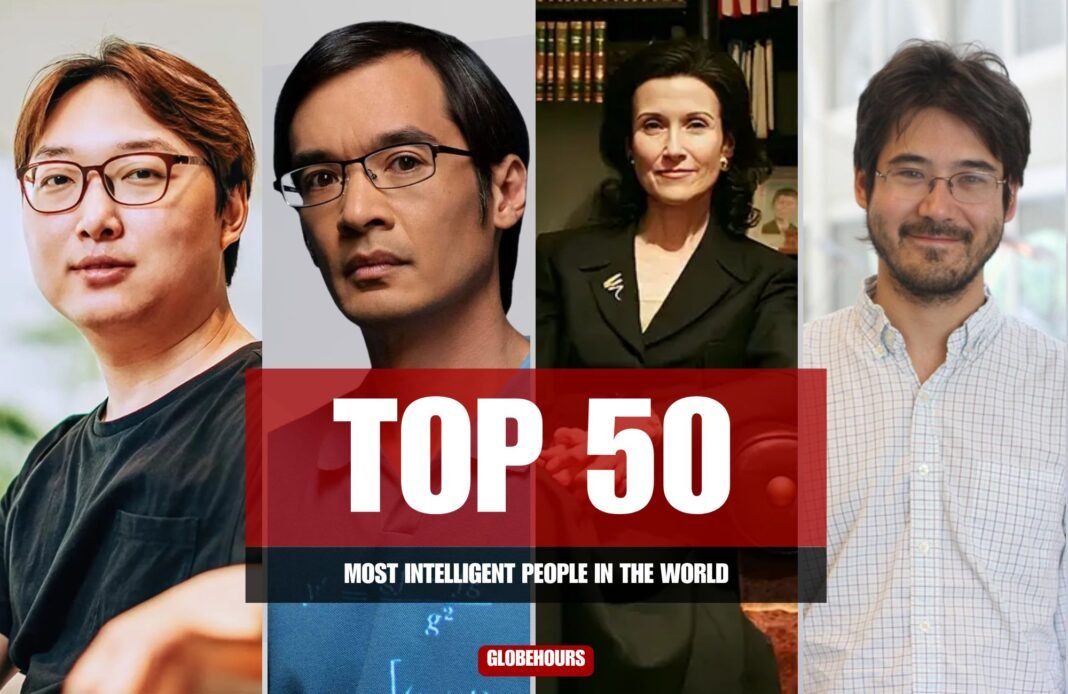
YoungHoon Kim
Dr. YoungHoon Kim holds the world record for the highest verified IQ score of 276, officially recognized by the World Record Academy and multiple high-IQ societies including the GIGA Society. His achievements span psychology, neuroscience, linguistics, and theology. He was recognized by CNN, CNBC, Reader's Digest, and The Economist as the person with the world's highest IQ in 2024.
Terence Tao
The Australian-American mathematician is widely considered the greatest living mathematician. A child prodigy who could perform arithmetic at age 2, Tao became the youngest gold medalist in International Mathematical Olympiad history at 13. He earned his Ph.D. from Princeton at 20 and received the prestigious Fields Medal in 2006. Currently a UCLA professor, he continues producing breakthroughs in prime numbers and harmonic analysis.
Marilyn vos Savant
Listed in the Guinness Book of World Records for the highest recorded IQ from 1986-1989, Marilyn vos Savant achieved her remarkable score on the Stanford-Binet test at age 10. She writes the famous "Ask Marilyn" column for Parade magazine, solving complex logic puzzles and mathematical problems. Her husband Robert Jarvik designed the first successful artificial heart.
Christopher Hirata
The Japanese-American astrophysicist became the youngest American to win a gold medal at the International Physics Olympiad at age 13. He enrolled at Caltech at 14 and began working for NASA at 16, investigating Mars colonization feasibility. He earned his Ph.D. from Princeton at 22 and is currently a professor at The Ohio State University, specializing in dark energy and gravitational lensing.
Kim Ung-Yong
A former child prodigy who was listed in the Guinness Book of World Records, Kim Ung-Yong could read Korean, Japanese, English, and German by age 3. He joined NASA at just 8 years old and reportedly earned a doctorate in physics while in the United States. After returning to South Korea in 1978, he earned a Ph.D. in civil engineering and has devoted his life to academia.
Sho Yano
Sho Yano gained worldwide attention by graduating from the University of Chicago at age 12, becoming the youngest student to earn a bachelor's degree from the institution. He then went on to earn his MD from the Pritzker School of Medicine at 21, becoming one of the youngest medical doctors in American history. His work spans medicine, genetics, and molecular biology.
Evangelos Katsioulis
The Greek psychiatrist won the World Genius Directory's 2013 Genius of the Year Award with an IQ of 198. He holds an M.Sc. in medical research, a master's in philosophy, and a Ph.D. in psychopharmacology from Aristotle University. In 2001 he founded the World Intelligence Network IQ society and is a member of 28 IQ societies including the exclusive Giga Society.
Christopher Harding
Christopher Harding is an Australian high-IQ individual and founder of the International Society for Philosophical Enquiry (ISPE), one of the world's oldest high-IQ societies. He was listed in the Guinness Book of World Records from 1966 to 1988 under the category "Smartest Man in the World" with an IQ score ranging from 196-197.
Christopher Langan
Known as "the smartest man in America," Christopher Langan taught himself to read by age 4 and reportedly scored 100% on his SAT while sleeping through parts of it. A self-educated autodidact, he developed the "Cognitive-Theoretic Model of the Universe" (CTMU), a theory attempting to unify science, philosophy, and theology while working various jobs including as a bouncer.
Rick Rosner
Richard Rosner is an unusual genius who has worked as a TV writer for Jimmy Kimmel Live! while also having been employed as a stripper, doorman, and model. He placed second in the World Genius Directory's 2013 Genius of the Year Awards. Rosner famously appeared on Who Wants to Be a Millionaire? and has spent years studying to compete with the world's highest IQ holders.
Garry Kasparov
Arguably the most famous chess player of all time, Garry Kasparov became the youngest-ever outright world champion in 1985 at age 22. He held the world number one ranking longer than anyone else in history. In 1996, he famously defeated IBM's Deep Blue computer, though he lost to an upgraded version in 1997. He retired from chess in 2005 to focus on politics and writing.
Mislav Predavec
Croatian mathematics professor Mislav Predavec has taught at Zagreb's Schola Medica Zagrabiensis since 2009. He founded the exclusive IQ society GenerIQ in 2002 and runs trading company Preminis. In 2012, the World Genius Directory ranked him as the third smartest person in the world. He specializes in creating very difficult intelligence tests as a hobby.
Edward Witten
Described as "the world's greatest living theoretical physicist," Edward Witten is renowned for his contributions to string theory, M-theory, quantum gravity, and supersymmetry. Despite being a physicist, he won the prestigious Fields Medal in 1990 for his impact on mathematics. TIME magazine included him among the 100 most influential people in 2004.
Nikola Poljak
Croatian physicist Nikola Poljak works as a researcher at the University of Zagreb and collaborates with CERN on the Large Ion Collider Experiment. He also works with Brookhaven National Laboratory on the STAR detector experiment. Born in 1982, he received his Ph.D. in physics in 2010 and has carried out scientific assignments for the Croatian Ministry of Science.
John H. Sununu
With an IQ of 180, John H. Sununu studied mechanical engineering at MIT, earning his Ph.D. in 1966. He worked as a professor at Tufts University before entering politics. He served as Governor of New Hampshire from 1983-1989 and then became White House Chief of Staff under President George H.W. Bush. He is eligible for membership in the elite Mega Society.
Ivan Ivec
Croatian mathematician Ivan Ivec holds a Ph.D. in mathematics and works at Gimnazija A.G.Matoša High School in Zagreb. He is an IQ test specialist who designs tests covering IQ ranges between 120 and 190. He has collaborated with fellow mathematician Mislav Predavec on developing intelligence tests and maintains a website dedicated to IQ testing research.
Judit Polgár
Acknowledged as the best female chess player in history, Judit Polgár became a grandmaster at 15, breaking Bobby Fischer's record. She has beaten nine world champions including Garry Kasparov. She is the only woman ever to have been ranked in the World Chess Federation's Top 100. Her success was partly an experiment by her father to prove "geniuses are made, not born."
Neil deGrasse Tyson
The renowned American astrophysicist serves as Director of the Hayden Planetarium in New York City. He earned his Ph.D. from Columbia University and has received numerous awards including a NASA Distinguished Public Service Medal. Known for popularizing science through TV shows and social media, Asteroid 13123 Tyson was named in his honor in 2001.
Magnus Carlsen
The Norwegian chess grandmaster became a grandmaster in 2004 at age 13 and the world's youngest number one-ranked player at 19 in 2010. He was World Chess Champion from 2013-2023 and has won four Chess Oscars. Trained briefly by Garry Kasparov, Carlsen is considered by many as the greatest chess player of all time, dubbed "the Justin Bieber of chess."
Manahel Thabet
Yemeni economist Manahel Thabet became the youngest person to receive a financial engineering Ph.D. magna cum laude at age 25 in 2008. In 2012, she developed a revolutionary 350-page formula to calculate distance in space without light. She received the Genius of the Year Award and Women of the Year Award from the Women's Federation for World Peace.
Andrew Wiles
English mathematician Andrew Wiles proved Fermat's Last Theorem in 1995 after 358 years it remained unsolved. The Guinness Book of World Records had listed it as one of the world's "most difficult mathematical problems." He earned degrees from Oxford and Cambridge and has held professorships at Princeton and Harvard. His awards include the Abel Prize and a knighthood.
Grigori Perelman
Russian mathematician Grigori Perelman solved the famous Poincaré conjecture in 2002, one of topology's most complex problems. He declined both the Fields Medal in 2006 and the $1 million Clay Millennium Prize in 2010, saying "I know how to control the universe. Why would I run to get a million?" He lives modestly with his mother in Saint Petersburg.
Noam Chomsky
Called the "father of modern linguistics," Noam Chomsky's revolutionary work has influenced artificial intelligence, music theory, and cognitive science. He enrolled at the University of Pennsylvania at 16 and earned his Ph.D. in linguistics. Named the "world's top public intellectual" in a 2005 poll, he has written over 100 books and remains politically active at 96.
Ruth Lawrence
British mathematician Ruth Lawrence made headlines in 1985 when she earned her bachelor's degree in mathematics from Oxford at age 13 with a starred first. She obtained her D.Phil. in mathematics at 18 and became a Harvard junior fellow at 19. She is currently an associate professor at Hebrew University of Jerusalem, specializing in algebraic topology and knot theory.
Donald Knuth
Called the "father of algorithmic analysis," Donald Knuth created the multi-volume masterpiece "The Art of Computer Programming" and the revolutionary TeX typesetting system. He earned his Ph.D. from CalTech in 1963 and received the A.M. Turing Award and National Medal of Science. He is currently a professor emeritus at Stanford University.
Saul Kripke
Award-winning logician and philosopher Saul Kripke was a child prodigy who learned Ancient Hebrew by age 6 before quickly mastering complex mathematics. His 1980 book "Naming and Necessity" revolutionized the philosophy of language. A 2009 poll ranked him as the seventh most important philosopher of the past 200 years. He received the Rolf Schock Prize in 2001.
Alan Guth
American physicist Alan Guth proposed the groundbreaking theory of cosmic inflation in 1981, explaining conditions before the Big Bang. He has been called "the man who put the 'big' in 'Big Bang.'" Guth left high school early to attend MIT, where he earned his bachelor's, master's, and doctorate in physics. He has held positions at Princeton, Columbia, and Stanford.
Steven Pinker
Canadian psycholinguistics expert Steven Pinker is currently a professor of psychology at Harvard. His work spans popular science, experimental psychology, linguistics, and cognitive science. TIME magazine featured him among the 100 most influential thinkers in 2004. His bestselling book "The Blank Slate: The Modern Denial of Human Nature" has influenced debates on human nature.
Akshay Venkatesh
Former child prodigy Akshay Venkatesh earned bronze medals at the International Physics and Mathematics Olympiads at ages 11 and 12. He became the youngest person to study at the University of Western Australia, earning first-class honors in pure mathematics at 16. He received the Fields Medal in 2018 and is currently a professor at Stanford University.
Shahriar Afshar
Iranian-American physicist Shahriar Afshar is known for his controversial 2004 Afshar experiment at Harvard, which investigates quantum complementarity. He has won numerous awards for his inventions including the award-winning "4D" Soundkix mini speaker. He is CEO of consumer electronics startup Immerz and a visiting research professor of physics at Rowan University.
Scott Aaronson
Computer scientist Scott Aaronson specializes in quantum computing and computational complexity theory at MIT. He received the Alan T. Waterman Award in 2012 for "illuminating the fundamental limits on what can be computed in the physical world." He earned his Ph.D. from UC Berkeley and is known for key contributions to algebrization and quantum Turing machines.
Elon Musk
The billionaire entrepreneur behind Tesla, SpaceX, Neuralink, and xAI, Elon Musk has revolutionized multiple industries. He taught himself computer programming at age 10 and sold his first software at 12. He holds degrees in economics and physics from the University of Pennsylvania. His ventures in electric vehicles, space exploration, and AI continue to shape technological advancement.
Stephen Hawking
Though he passed away in 2018, Stephen Hawking remains an icon of intelligence. Best known for his pioneering work on black holes and his bestselling book "A Brief History of Time," he earned his Ph.D. from Cambridge despite being diagnosed with ALS at 21. His guest appearances on The Simpsons and Star Trek cemented his place in popular culture.
Paul Allen
Microsoft co-founder Paul Allen had a reported IQ of 160-170. He co-founded Microsoft with Bill Gates in 1975 and later became a renowned philanthropist, donating over $1.5 billion to science, education, and conservation. He launched the Allen Institute for Brain Science and founded space transport company Stratolaunch Systems before his death in 2018.
James Woods
American actor James Woods reportedly has one of the highest IQs in Hollywood, scoring 180 or above. He achieved a near-perfect SAT score of 1579 and attended MIT on a full scholarship to study political science before leaving to pursue acting. He has won two Emmy Awards and been nominated for two Academy Awards throughout his acclaimed career.
Demis Hassabis
British AI researcher Demis Hassabis co-founded DeepMind, which created AlphaGo and AlphaFold. He was a chess prodigy and earned his Ph.D. in cognitive neuroscience from UCL. In 2024, he received the Nobel Prize in Chemistry for AlphaFold's breakthrough in protein structure prediction. TIME named him one of the 100 most influential people in the world.
Peter Higgs
British theoretical physicist Peter Higgs proposed the existence of the Higgs boson in 1964, a particle confirmed by CERN in 2012. He received the Nobel Prize in Physics in 2013 for his work explaining how particles acquire mass. The Higgs mechanism is fundamental to the Standard Model of particle physics. He passed away in April 2024.
Fei-Fei Li
Chinese-American computer scientist Fei-Fei Li is known as one of the most influential figures in AI. She created ImageNet, a dataset that revolutionized computer vision and deep learning. She is a professor at Stanford University and served as Chief Scientist of AI/ML at Google Cloud. TIME named her among the 100 most influential people in 2023.
Roger Penrose
British mathematician and physicist Roger Penrose won the Nobel Prize in Physics in 2020 for proving that black holes are a direct consequence of general relativity. He collaborated with Stephen Hawking on singularity theorems and invented the famous Penrose stairs optical illusion. At 94, he remains active in research on consciousness and cosmology.
Ramarni Wilfred
British prodigy Ramarni Wilfred achieved an IQ score of 162 at age 11, higher than Einstein's estimated IQ. He became the youngest Mensa member in his country and has given lectures on philosophy and ethics. Now in his early 20s, he continues his studies in psychology and philosophy, aiming to contribute to understanding of human consciousness.
Tanishq Abraham
Indian-American prodigy Tanishq Abraham joined Mensa at age 4 and earned his high school diploma at 10. He graduated from American River College at 11 with three degrees and became one of the youngest to attend UC Davis. He has interned at NASA and studied biomedical engineering, focusing on developing AI for medical diagnostics.
Yann LeCun
French-American computer scientist Yann LeCun is one of the "godfathers of AI" and won the Turing Award in 2018 for his work on deep learning. He developed convolutional neural networks that revolutionized image recognition. Currently serving as Chief AI Scientist at Meta, he continues pushing the boundaries of machine learning and artificial intelligence.
Geoffrey Hinton
British-Canadian cognitive psychologist Geoffrey Hinton is known as the "Godfather of AI" for pioneering deep learning and neural networks. He won the Turing Award in 2018 and the Nobel Prize in Physics in 2024 for foundational discoveries in machine learning. He famously left Google in 2023 to speak openly about AI risks and safety concerns.
Yoshua Bengio
Canadian computer scientist Yoshua Bengio is one of the three "godfathers of deep learning" who shared the 2018 Turing Award. He is a professor at the University of Montreal and scientific director of Mila, the Quebec AI Institute. His research on neural networks and sequence-to-sequence learning has shaped modern natural language processing.
Marvin Klotz
American mathematician and high-IQ society member Marvin Klotz has contributed to various mathematical publications and IQ test development. He is a member of multiple high-IQ societies and has collaborated with other geniuses on developing standardized intelligence assessments that push the boundaries of measuring exceptional cognitive abilities.
Nathan Myhrvold
Former Microsoft CTO Nathan Myhrvold holds a Ph.D. in theoretical physics from Princeton and studied with Stephen Hawking at Cambridge. He founded Intellectual Ventures and authored the award-winning "Modernist Cuisine" cookbook series. He is also a nature photographer and paleontologist who has discovered several dinosaur species on expeditions.
Viswanathan Anand
Indian chess grandmaster Viswanathan Anand was the undisputed World Chess Champion from 2007-2013 and five-time world champion overall. He became India's first grandmaster in 1988 and has won numerous Chess Oscars. Known for his speed chess abilities, he continues to compete at the highest levels while mentoring the next generation of Indian chess players.
Jennifer Doudna
American biochemist Jennifer Doudna co-developed CRISPR-Cas9 gene editing technology, earning the Nobel Prize in Chemistry in 2020. Her breakthrough allows scientists to edit DNA with unprecedented precision, revolutionizing genetics and medicine. She is a professor at UC Berkeley and continues researching applications of gene editing for treating diseases.
Shakuntala Devi
Known as the "Human Computer," Indian mathematical prodigy Shakuntala Devi demonstrated extraordinary calculation abilities from childhood. She held the Guinness World Record for multiplying two 13-digit numbers mentally in 28 seconds. Though she passed away in 2013, her legacy continues to inspire mathematicians worldwide and was celebrated in a 2020 biographical film.
Sabrina Gonzalez Pasterski
Cuban-American physicist Sabrina Gonzalez Pasterski built her first aircraft at age 14 and flew it at 16. She graduated first in her class from MIT at 19 and earned her Ph.D. from Harvard at 24. Often called "the next Einstein," her research focuses on high energy physics, quantum gravity, and black holes. She founded the Pasterski Foundation to support physics research.